
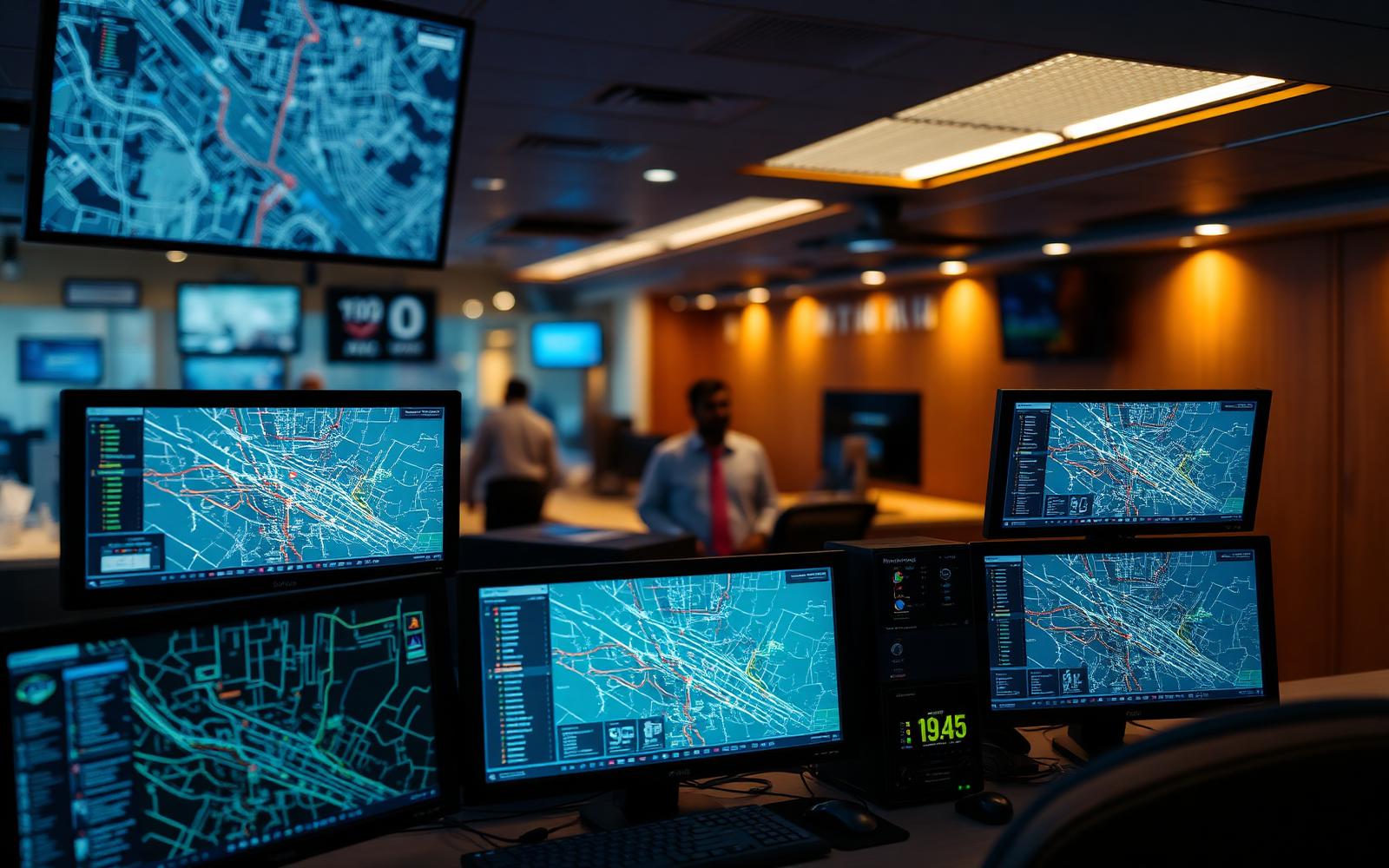
"TMS" gets used loosely in India — for logistics freight platforms, for ride-hailing dispatch tools, and for corporate employee-transport software. This guide is scoped to the third: Transport Management Systems for Indian corporates moving employees between homes, offices, tech parks and airports, often across mixed fleets of own, vendor and driver-cum-owner (DCO) vehicles.
What a corporate TMS actually does
A modern TMS for Indian corporate transport covers seven capability blocks:
- Masters & onboarding — vehicles, drivers, vendors, DCOs, corporate clients, rate cards.
- Rostering — pick-up/drop shifts, ad-hoc trips, bulk XLSX upload with validation.
- Dispatch & routing — auto-allocation, ETA computation, escort rules for night shifts.
- Live tracking — AIS 140 / driver-app GPS, geofences at tech parks and residences.
- Safety & compliance — SOS button, female-employee escort logs, document-expiry alerts.
- Billing & settlements — GST invoices, vendor payouts, DCO advances, SLA penalties.
- MIS & analytics — cost-per-km, on-time %, vendor scorecards, HR chargebacks.
Corporate employee TMS vs logistics TMS
A freight/logistics TMS optimises long-haul lanes and generates LR / Bilty documents and E-way bills under GST. A corporate employee-transport TMS optimises a different problem: getting knowledge workers to their desks safely and on time, in mixed traffic, with women's night-shift compliance and per-employee chargebacks. The data models overlap; the priorities do not.
Non-negotiable capabilities for Indian corporates
- Women's night-shift safety — geofence-based escort rules, live SOS, and audit trail (see the Karnataka / Noida / Delhi NCR compliance playbook).
- Geofenced tech-park logs — auto entry/exit events for boom-barrier and billing reconciliation (geofencing deep-dive).
- Multi-vendor + DCO model — one system for own vehicles, vendor fleets and individual DCOs, each with their own rate cards, KYC and payouts.
- AIS 140 integration — for regulated cabs and school-style transport.
- GST-compliant invoicing — HSN codes, place-of-supply, RCM handling for DCOs.
- Maintenance & fuel controls — km-based service schedules and fuel-log reconciliation (maintenance playbook).
- Offline-tolerant driver app — India has thousands of weak-network stretches.
Integrations that decide long-term fit
- HRIS / SSO — Workday, SAP SuccessFactors, Darwinbox for roster sync and SAML/OIDC login.
- Finance — Tally, SAP, Zoho Books for GST-compliant invoice posting.
- Facility access — boom-barriers and visitor systems at tech parks.
- Communication — SMS + WhatsApp for OTP pick-up confirmation and delay alerts.
- Payments — UPI / bank push for DCO settlements and driver reimbursements.
Scoring TMS vendors — a 12-point matrix
Score every shortlisted vendor 0–5 on each row, weight the safety and billing rows 2×:
- India-specific safety compliance (Karnataka/Noida/NCR)
- Geofence accuracy and setup effort
- Rostering ergonomics for large shift patterns
- Multi-vendor + DCO model depth
- GST + RCM invoicing correctness
- SLA engine and penalty automation
- Driver-app UX in weak network
- Employee-app UX (pick-up ETA, SOS)
- Analytics and vendor scorecards
- Integration depth (HRIS, Tally/SAP)
- Data ownership and export
- Total cost of ownership at scale
A realistic ROI model
For a 100-vehicle Indian corporate mix (60 owned + 40 vendor/DCO), the typical 12-month TMS payback stack is:
- Fuel: 6–12% saving via idle/route control ≈ ₹18–36 L / year.
- Billing leakage: 3–5% recovered via vendor reconciliation ≈ ₹12–20 L / year.
- Ops productivity: 15–25% reduction in rostering & MIS effort ≈ 1–2 FTE.
- Safety incidents avoided: harder to quantify, but a single serious incident dwarfs annual SaaS cost.
Most 100-vehicle deployments recover TMS spend inside 4–7 months.
30/60/90-day rollout plan
- Days 0–30 — Foundation: load masters (vehicles, drivers, vendors, clients, rate cards), onboard drivers to the driver-app, wire SSO, freeze the roster template.
- Days 31–60 — Parallel run: generate rosters, dispatch and invoices in parallel with your incumbent process; reconcile weekly.
- Days 61–90 — Cutover: retire the legacy tool, activate SLA penalties and vendor scorecards, publish MIS to HR and Finance.
City-specific considerations
Local operating conditions change what a TMS must do out of the box. See the Hyderabad HITEC City routing playbook for a worked example — peak-hour lane logic, tech-park geofences and BPO night-shift safety patterns.
Every capability in this guide — rostering, dispatch, geofencing, women-safety compliance, GST invoicing, vendor scorecards — ships pre-configured in Fleet NEXUS India. Go live in weeks, not quarters.
Open your fleet dashboard